Easy Landscaping Drawing: A Guide to Plan Your Dream Yard
A lot of people begin a yard project the same way. They save photos, circle favorite plants, and build a mental picture of a space that feels calmer, cleaner, or more useful than the one outside their back door. Then they step into the actual yard, look at the slope, the fence line, the awkward utilities, the too-small patio, and everything goes fuzzy.
That’s where an easy landscaping drawing earns its keep.
A simple drawing gives shape to ideas before money gets spent. It helps you decide where people will sit, how they’ll move, what stays, what goes, and whether the “perfect” inspiration photo even fits your lot. It also exposes trade-offs early. A wider path may shrink a planting bed. A bigger dining area may crowd circulation near the grill. Those are good discoveries to make on paper.
When homeowners are still sorting budget priorities, I often suggest pairing a rough plan with practical budgeting advice like these smart tips for outdoor space remodels. The combination works well because the drawing organizes the design, while the budget guidance helps you sequence the work.
If you want inspiration before you start sketching, it also helps to review a visual planning workflow like this guide on how to design a landscape. Seeing how ideas move from concept to layout makes the blank page feel far less intimidating.
Your Starting Point for a Great Landscape Design
Saturday morning is when many yard projects stall. The homeowner has a head full of ideas, a tape measure in one hand, and a blank sheet of paper that suddenly feels too official to touch. That hesitation costs time. The first sketch is supposed to be rough.
Good drawing starts with observation. Stand where you use the yard. Look out from the kitchen window. Walk from the back door to the gate. Notice where the ground feels tight, where views are pleasant, and where practical problems keep showing up. I tell apprentices to draw those facts before they draw style.
Start with the site, not the look
A workable site plan begins with fixed elements. House corners, doors, windows, fences, existing trees worth protecting, utility boxes, steps, and drainage trouble spots all go on paper first. These are the conditions every design decision has to respect.
Scale sounds technical, but it is simple. It means one measured amount on paper stands in for a larger real-world amount in the yard. If 1 square on graph paper equals 1 foot, you can test whether a path, bed, or patio fits before anyone orders materials.
A yard plan is a thinking tool first. Presentation comes later.
That mindset saves beginners from a common mistake. They chase a polished drawing before they have made the hard choices. A clean-looking sketch that ignores gate swing, trash bin access, or water flow is less useful than a plain pencil plan that gets those basics right.
If you want to see how inspiration, layout, and visualization connect, this guide on how to design a yard plan from concept to layout is a helpful reference. It pairs well with the hand-drawing process because a solid sketch gives AI tools better input and better output.
Why paper still matters
Even now, I start many projects by hand. Paper is fast. It lets you test options without getting distracted by finishes, colors, or photorealistic effects too early.
A simple site plan helps in three practical ways:
- It exposes trade-offs early. A larger dining pad may pinch circulation. A wider path may reduce planting depth.
- It makes conversations clearer. Family members and contractors can point to a drawing and discuss real locations, sizes, and conflicts.
- It sets up better visualization later. Once the layout is sound, tools like Curb Appeal AI can turn that sketch into a clearer picture of the finished yard.
That last point matters. AI images are useful, but they work best when the bones are already decided. A loose paper sketch gives structure to the prompt, keeps the design grounded in your actual site, and helps turn an idea into something a contractor can price and build.
If budget is still shaping the scope, pair your sketch with these smart tips for outdoor space remodels. The combination works well. The drawing helps you decide what belongs in phase one, and the budget plan helps you decide what can wait.
A rectangle for the house, a few fence lines, door locations, and circles for existing trees is enough to begin. Clear beats fancy. Every time.
Laying the Groundwork Measuring and Mapping Your Site
A homeowner sketches a patio that looks generous on paper. Then the tape measure comes out, and the gate clearance disappears, the dining table crowds the back door, and the side path shrinks to a squeeze. That usually traces back to one problem. The base map was never measured carefully.
Accurate site drawing is less about artistic skill and more about getting the fixed dimensions right before you make design decisions. I teach apprentices to slow down here, because a clean measured plan saves far more time than it costs. It also gives AI tools better raw material later. If you feed Curb Appeal AI a sketch that matches the site, the visual output has a much better chance of reflecting something you can build.
The simple tool kit
You do not need specialty gear for an easy yard drawing. Start with a few dependable basics:
- A measuring tape: Outdoor design guidance recommends using 100 to 200 foot tapes for site measuring, especially on larger properties (UF/IFAS guidance on creating a base map).
- Graph paper and a clipboard: These help keep dimensions legible and make scale easier to manage.
- Pencils and an eraser: Early plans change. Pencil keeps the process flexible.
- A property survey if you have one: It can give you boundary lines, structure locations, and other baseline dimensions that are worth checking before you draw.
If you are unsure how formal measurement fits into the planning process, these expert insights on site surveys explain where survey information prevents expensive mistakes.

What to measure first
Start with what will not move. The house, property edges, paved areas, fences, retaining walls, utility points, and mature trees matter more at this stage than small shrubs or seasonal pots.
Use this order:
- Property boundaries from a survey or deed, if available.
- House walls and projections such as steps, bay windows, corners, and porches.
- Doors and windows that shape circulation, access, and sightlines.
- Driveways, walks, and existing paved areas.
- Permanent site features such as sheds, fences, drains, air-conditioning units, retaining walls, and large trees.
Measure from fixed reference points whenever possible. House corners are dependable. The middle of a lawn is not.
That one habit prevents a lot of redraws. Once one line is guessed, every attached dimension starts drifting.
Scale without the headache
Scale sounds technical, but the idea is simple. It means every line on paper stands in for a larger real-world dimension using the same ratio throughout the drawing.
For many home projects, that means choosing a scale that fits the yard on one sheet while still leaving room for notes. According to scale guidance from iPlantsman, common plan scales include 1:50 for smaller gardens and 1:100, 1:200, or 1:500 for larger spaces. At 1:50, 1 cm on paper equals 50 cm on site.
If you work in feet and inches, 1/8 inch = 1 foot or 1/4 inch = 1 foot are common residential scales. The best choice depends on yard size and sheet size. The rule is consistency. Change scales halfway through and the drawing stops being trustworthy.
A clean transfer method
Transfer the measurements to paper in the same order you measured them. Draw the house first. Add property lines next. Then place paving, fences, walls, trees, and utilities.
That order keeps the geometry stable.
| Drawing habit | What happens |
|---|---|
| House first | Other features can be located from real reference points |
| Property lines confirmed early | Setbacks and clearances are easier to judge |
| One consistent scale | Paths, beds, and patios stay proportional |
| Guessing or mixing units | Conflicts show up during layout or construction |
A base map is plain work, but it is where good projects start. Once this sheet is accurate, you can sketch ideas freely by hand, test options with confidence, and then use that same plan as a strong input for AI visualization instead of asking software to fix a weak layout.
Designing the Bones Drawing Hardscapes and Garden Beds
A good plan starts to feel real at this stage. The yard is no longer a loose set of ideas. It becomes a layout you can test, revise, and eventually hand to a contractor or feed into AI tools for a more realistic preview.
In the professional site drawing process, designers often begin with bubble diagrams before they commit to exact shapes. Unilock also shows this progression from early functional planning into hardscape layout in its overview of the professional site drawing process.

Use bubble diagrams before drawing exact shapes
Lay tracing paper over the base map and draw loose circles for how the yard needs to work. Dining area. Grill zone. Open lawn. Quiet seat. Storage or service path.
This step saves time because function gets sorted out before style enters the drawing. I teach apprentices to keep these first marks fast and disposable. If someone has to squeeze past a dining table to reach the bins, or if the only sunny sitting area faces the neighbor’s AC unit, the problem is easier to fix now than after you have fallen in love with a patio shape.
A few questions sharpen the sketch fast:
- Where do people step out of the house most often?
- Which route should feel direct?
- Where is shade helpful, and where will sun make the space usable?
- What deserves privacy, and what should stay visually open?
Bubble diagrams are simple, but they do hard work. They also translate well into modern visualization. If you later use a tool like Curb Appeal AI, a clear hand-drawn zoning plan gives the software better direction than a vague prompt ever will.
Turn the bubbles into hardscape
Once the use zones make sense, draw the built elements that support them. A dining area may become a rectangle because tables and chairs fit better on straight edges. A sitting area might become a small circular gravel court if the goal is enclosure and informality. A path can be straight, gently curved, or broken into runs, but each choice changes cost, layout difficulty, and how the space feels underfoot.
Material affects geometry. Large-format pavers usually suit cleaner lines and fewer directional changes. Smaller units can handle tighter curves and more traditional patterns with less cutting. That is a design decision and a construction decision at the same time.
A few trade-offs come up on nearly every residential plan:
- Larger patio: Better for hosting, but it reduces rooting space, screening, and rain absorption.
- Curved path: Softer visually, but harder to lay out cleanly if it does not relate to the house or lot lines.
- Straight path: Efficient and easy to build, but too many rigid lines can make a small yard feel stiff.
- Wide steps and landings: More comfortable to use, but they can dominate a compact entry.
If a path looks awkward on paper, it usually feels awkward when built. Trust that reaction.
Draw garden beds from the edges of the hardscape
Beginners often sketch bed shapes first and push paving into whatever space remains. That approach usually creates thin leftover strips and fussy curves. Place the patio, walks, and steps first. Then shape the planting areas around them.
This is how cleaner plans happen. Beds can frame a terrace, widen at a corner where shrubs need depth, or tighten along a walk to keep circulation comfortable. The best bed lines look intentional. They guide movement, soften masonry, and give plants enough soil volume to mature properly.
One quick check helps. Squint at the drawing. If every edge wiggles, simplify. If every line is rigid, ease one or two transitions so the plan does not feel mechanical.
That paper plan is still doing important work here. It helps you resolve proportion and buildability before you chase finishes or photorealistic effects. Once the bones are sound, digital visualization becomes far more useful because it is interpreting a real design instead of decorating a weak one.
Adding Life and Detail Choosing Symbols and Annotations
A contractor, nursery, and homeowner should all be able to read the same plan and reach the same conclusion. That is when a sketch starts doing real work.

Keep the symbol system small
Beginners often add too many symbols too soon. The drawing gets busy, and the message gets muddy.
Use a short, repeatable set and stay consistent from one corner of the plan to the other:
- Tree symbol: A circle with a small trunk mark
- Shrub mass: A soft cloud outline
- Perennials or grasses: Repeated small circles or grouped ticks
- Groundcover: A light hatch or texture fill
The exact graphic style matters less than consistency. If one symbol stands for boxwood in one bed and hydrangea in another, the plan stops being clear.
Draw plants at mature size
This habit prevents crowded beds better than any other. Draw the spread each plant will reach after establishment, not the size of the nursery pot sitting in the cart today.
That can feel sparse on paper, especially to beginners. It is still the right move. Plants need room for airflow, root expansion, maintenance access, and the shape they are supposed to have.
I tell apprentices the same thing every season. A planting plan should predict year three, not flatter day one.
Groups usually read better than isolated singles, but the right quantity depends on the plant, the width of the bed, and the effect you want. A mass of small grasses works differently from three structural shrubs at an entry.
Use a plant key like a contractor will read it
A plant key turns a nice drawing into a usable one. Keep it plain. List the code, plant name, planned size, quantity, and any note that affects pricing or installation.
A simple key might include:
| Code | Plant | Size | Quantity | Notes |
|---|---|---|---|---|
| T1 | Accent tree | 1 or 5 gallon | 1 | Entry focal point |
| S1 | Evergreen shrub | 1 gallon | grouped | Screening layer |
| P1 | Perennial | 1 gallon | grouped | Seasonal color |
There is a real trade-off in plant sizing. Larger nursery stock gives faster visual impact, but the price climbs quickly and the planting crew has more weight to handle. Smaller material usually stretches the budget further and often establishes well in mass plantings. Near a front door or a key view, spending more on a few larger plants can make sense.
Add annotations that answer jobsite questions
Good notes save phone calls. Label widths, lengths, materials, and anything a builder would otherwise have to guess.
Write clear phrases such as “gravel path,” “clay brick walk,” “mulch bed,” “seat wall,” or “drip irrigation to shrub areas.” If a bed edge needs steel edging, note it. If a tree must stay clear of overhead lines or a walkway needs a comfortable width, write that down too.
This is also where simple paper planning starts to connect with modern visualization. Clean labels, plant codes, and material notes give you a stronger prompt for tools that generate concept views from a base plan. If you want to turn a hand sketch into something easier for clients to picture, an online landscape design tool for AI-assisted visualization works best when the underlying drawing is already organized.
Messy annotation creates confusion. Clear annotation creates options.
From Sketch to Reality Visualizing with Landscaping AI
A top-down plan is excellent for spacing, layout, and construction logic. It’s weak at showing atmosphere.
Most homeowners can understand a patio dimension. Fewer can look at a flat drawing and instantly feel what the front walk, entry planting, and facade balance will look like from the street. That’s the visualization gap.

Why perspective matters
Long before AI tools arrived, designers used perspective sketching to close that gap. The method is manual but effective. You trace over a site photo, establish vanishing points, and build the drawing so paths, lawns, and walls recede properly.
According to the Drawn to Garden material, this photo-overlay process is ideal for curb appeal visuals, and professionals report it improves spatial accuracy by 80%. The same source also notes that digital drawing workflows in tools like Morpholio Trace have cut master plan time by 50% and reached 92% client approval in real estate staging contexts (perspective sketching and digital visualization methods).
That’s the bridge between old-school drawing and newer visualization tools. The logic is the same. The interface changes.
Use the paper plan as your decision filter
Many people often become careless when using AI. They upload a photo and start chasing pretty images without grounding them in an actual plan.
The better sequence is this:
- Measure and draw the site.
- Decide where the major hardscape and bed zones belong.
- Choose a style direction.
- Use visualization tools to test how that direction feels from human eye level.
When the paper plan comes first, the renderings stay tethered to reality. You’re not just asking for “something modern.” You’re asking to see a modern planting composition around a path that already exists in your scaled plan, with a patio where circulation already makes sense.
If you want a digital tool for that stage, this overview of an online landscape design tool shows how people use visual mockups during early planning.
Where AI helps and where it doesn’t
Used well, AI visualization is fast feedback. It helps homeowners compare style directions, facade balance, material moods, and planting density before they commit.
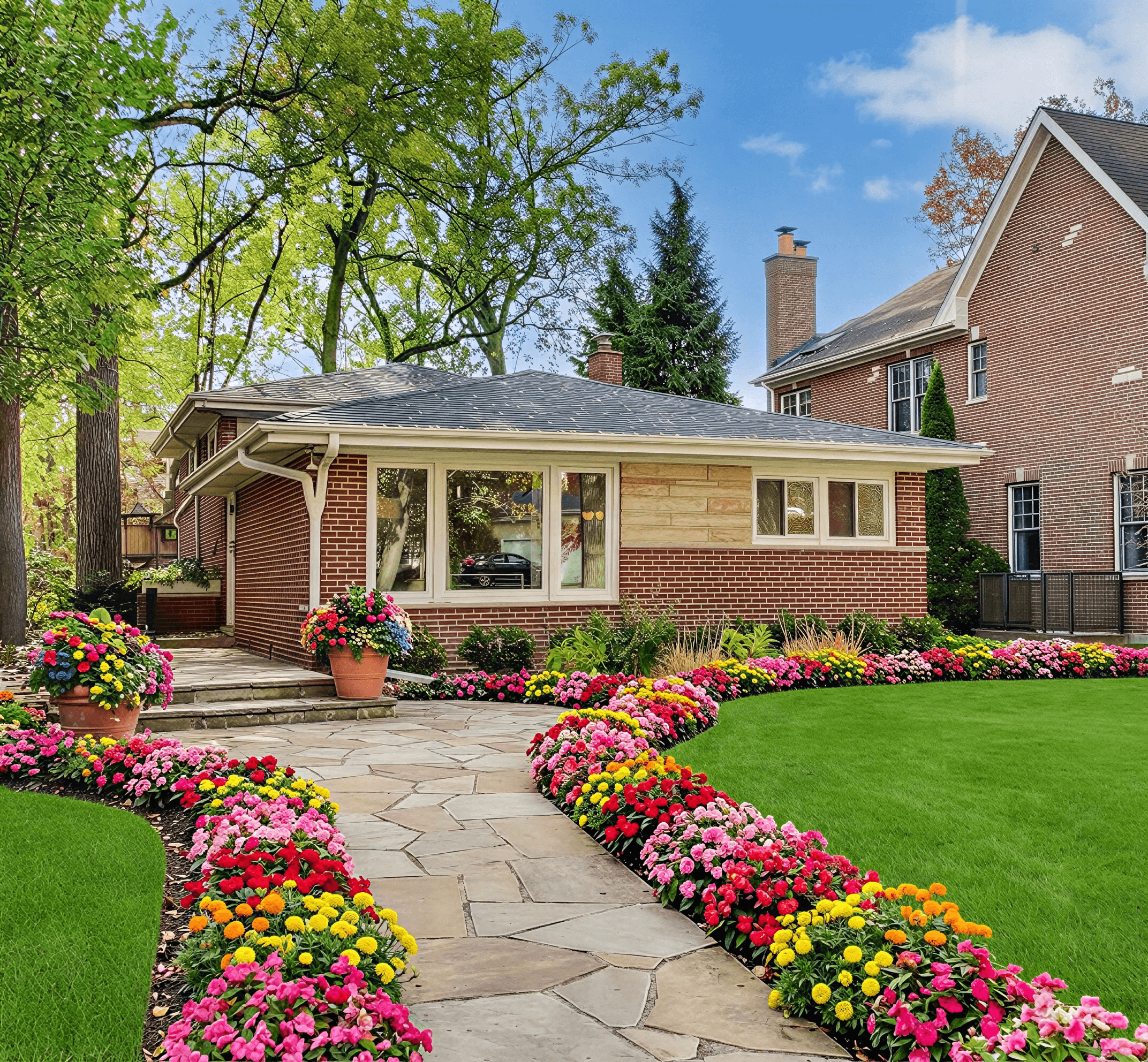
One example is Curb Appeal AI, which lets users upload a street-view style photo, select from multiple design styles, and generate photorealistic exterior concepts shaped by architecture and local climate inputs. That’s useful when you already know the bones of the plan and want to test how a clean modern bed line differs from a softer cottage arrangement in front of the same house.
AI does not replace site judgment.
It won’t automatically know that a tree canopy blocks afternoon light in an important seating area, or that a gate swing needs clearance, or that a drainage swale should stay open. Your measured drawing still carries the technical responsibility.
A quick demo helps make that workflow concrete:
The strongest workflow is hybrid
The most dependable process combines both worlds:
- Hand drawing for scale, logic, and buildable relationships
- Photo-based visualization for realism and confidence
- Contractor documentation for execution
That hybrid approach is what I teach because it respects how outdoor designs succeed. First you think clearly. Then you visualize. Then you build.
Final Touches Preparing Your Drawing for a Contractor
By the time you’re ready to talk with contractors, your drawing should no longer look like the page you carried around the yard. Keep that rough version for reference, but produce a clean final copy.
Contractors can work with a simple homeowner plan if it’s legible, scaled consistently, and fully labeled. They struggle when the drawing contains half-decisions, crossed-out dimensions, and unlabeled materials. A cleaner sheet saves time because everyone starts from the same understanding.
What the final plan must include
Before you send the drawing out for bids, check for these essentials:
- Clear dimensions: Label key lengths, widths, and offsets so no one has to guess.
- A readable legend: Plant codes, material notes, and any abbreviations should be easy to decode.
- Named surfaces and edges: Call out pavers, gravel, mulch, lawn, and bed lines.
- Your name and date: Small detail, big help when versions start circulating.
Contractors price uncertainty. The fuzzier the plan, the more protective their estimate usually becomes.
That doesn’t mean you need a fully engineered package for a modest yard refresh. It means the drawing should answer the obvious questions before someone sets foot on site.
Make bidding easier on yourself
Print multiple copies or save a clean digital version you can share consistently. Give each contractor the same drawing, the same notes, and the same priorities. That creates fairer comparisons.
If you’re trying to understand what more formal drawing packages can cost in a regulated planning context, these notes on Bournemouth planning drawing expenses offer useful context. The exact process varies by project and location, but the takeaway is universal. Clear drawings have value because they reduce confusion.
If you later decide you want outside help refining the concept or turning it into a more developed package, this guide to landscape design services can help you see where professional support fits.
A good final drawing doesn’t need to be fancy. It needs to be organized. That’s what puts you in control of the conversation and gives the contractor a real chance to build what you intended.
A clear sketch is often the moment a yard project stops feeling vague and starts feeling possible. If you want to move from measured plan to realistic visuals, Curb Appeal AI gives you a way to turn your ideas into photorealistic exterior concepts you can compare, refine, and share with confidence.